From Soil to Seal: How Owning the Entire Process Changes What Ends Up in Your CBD Gummy

Pick up almost any CBD gummy on the market and flip it over. The label might look polished, the branding might feel premium, and the marketing copy probably talks a lot about "quality" and "purity." But here's a question most brands would rather you didn't ask: who actually grew the hemp in that gummy?
For a surprising number of CBD companies, the honest answer is — they have no idea. Not really. They purchased an extract from a broker, who sourced it from a processor, who bought raw biomass from a farm they may have never visited. By the time that ingredient gets blended into a gummy and sealed in a bag with your name on it, it's passed through four or five different hands, each one adding a layer of separation between the brand and the origin of what you're putting in your body.
This is the supply chain reality that most of the CBD industry doesn't advertise. And it matters more than you might think.
What "Vertical Integration" Actually Means (And Why It's Not Just a Buzzword)
Vertical integration is a supply chain term that describes a company's control over multiple stages of its own production process. In the CBD world, that means owning or directly managing everything from cultivating hemp plants to extracting CBD, formulating the final product, and packaging it for sale.
It sounds like an operational detail — the kind of thing that only matters to investors and logistics nerds. But for the person actually chewing a gummy and hoping it does something useful for their wellness routine, vertical integration has very direct consequences.
When a company controls its own hemp cultivation, it decides what seeds go into the ground, what soil amendments get used, whether pesticides are applied, and how plants are harvested. When it handles its own extraction, it controls the method used to pull CBD from the plant — and methods vary widely in how cleanly they preserve cannabinoids and how much residual solvent they leave behind. When it runs its own manufacturing, it sets the formulation standards, the dosing consistency, and the quality checkpoints that determine whether the gummy you take on Tuesday has the same potency as the one you took last Thursday.
Remove any one of those links from a brand's direct control, and you introduce variables. Remove all of them, and you've got a company that's essentially just a label.
The Hidden Risks in a Fragmented Supply Chain
Here's where things get genuinely important for consumers. Third-party sourcing isn't inherently dishonest — plenty of industries run on it just fine. But CBD is a product that people are relying on for real wellness outcomes. Inconsistency isn't just annoying; it can undermine the entire reason someone started taking CBD in the first place.
Consider potency. When a brand buys CBD extract from an outside supplier, it's trusting that supplier's batch testing. But batch-to-batch variation in hemp-derived extracts can be significant. One shipment might test at 85% CBD purity; the next might come in at 70%. If the brand's formulation team isn't catching that — and in many cases they're not, because testing adds time and cost — those discrepancies end up in the finished product. Your 25mg gummy might actually be delivering 18mg one month and 30mg the next.
Purity is an even bigger concern. Hemp is a bioaccumulator, meaning it absorbs whatever is in the soil around it — including heavy metals, pesticide residues, and other contaminants. A brand that doesn't control its own farming has no real visibility into what conditions its hemp was grown in. A third-party certificate of analysis can tell you what's in the final extract, but it can't always tell you why something undesirable showed up — or whether the next batch will be cleaner.
And then there's the traceability question. If something goes wrong — if a batch tests hot for THC, or a contamination issue surfaces — a vertically integrated brand can trace the problem back to its source and address it directly. A brand operating through a chain of outside vendors is playing detective with someone else's records.
What Golden Farm's Approach Looks Like in Practice
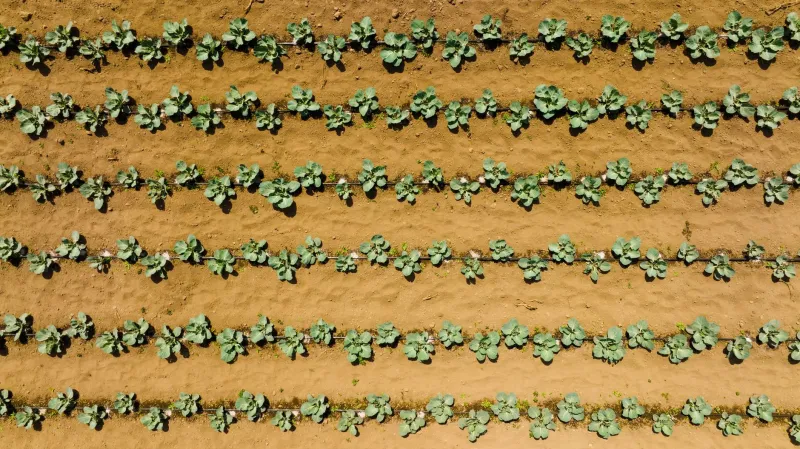
At Golden Farm, the name isn't incidental. The farm is the foundation. Hemp cultivation happens on our own land, under the direct oversight of our team, which means we're making the decisions about how our plants are grown from day one. We know the soil. We know the inputs. We know exactly when and how our hemp is harvested.
From there, extraction and processing happen within our own production system — no middlemen, no mystery brokers. We're not shopping around for whoever's offering the cheapest bulk extract this quarter. The same hemp that grows on our land becomes the CBD that ends up in every Golden Farm gummy.
Formulation and manufacturing follow the same principle. Our team controls the process of turning that extract into the finished gummy — the ratios, the ingredients, the consistency checks. When we say a gummy contains a specific amount of CBD, we've verified that at multiple stages, not just taken a supplier's word for it.
Third-party lab testing is still part of the picture — it should be for any reputable CBD brand. But when you control the upstream process, that testing is confirming what you already expect to see, rather than hoping an outside supplier didn't cut corners.
Why Consumers Deserve to Know This
The CBD market in the US is still maturing. Regulations are evolving, labeling standards aren't uniform, and there's genuinely a wide range of quality across brands. That environment puts a lot of responsibility on consumers to do their own homework — and it puts a corresponding responsibility on brands to be transparent about how they actually operate.
Asking a CBD brand "where does your hemp come from?" and "do you control your own manufacturing?" shouldn't feel like an unreasonable demand. It's the kind of question you'd ask about any health supplement you were planning to take daily.
Vertical integration isn't a marketing claim — it's an operational commitment that either exists or it doesn't. And when it does exist, it shows up in ways that matter: more consistent potency, cleaner ingredients, faster response when something needs to be corrected, and a brand that can actually stand behind what it's selling because it was involved in making it.
The Bottom Line
Not every CBD brand needs to own a farm. But if a brand can't tell you clearly where its hemp comes from, who extracted the CBD, and how its manufacturing process is controlled, that's a gap worth paying attention to.
At Golden Farm, we built the model around transparency because we think that's what wellness-conscious consumers actually deserve. Every gummy carries the weight of that commitment — from the soil it started in to the moment you open the bag. That's not a tagline. It's just how we do things.