Can You Actually Trace Your Supplement Back to the Ground It Grew In? Here's Why That Question Matters More Than You Think
Here's a question most supplement companies hope you never ask: Where, exactly, did this come from?
Not in a vague, "we source from trusted partners" kind of way. But specifically — which farm, which field, which harvest season, which soil? For the overwhelming majority of mass-market wellness products sitting on pharmacy shelves right now, the honest answer is: nobody really knows. And that gap between "we think it's fine" and "we can prove it" is where consumer trust goes to die.
At Golden Farm CBD Gummies, we think about this constantly. Because when your whole brand promise is nature's sweetness, wellness you can feel, you can't afford to shrug at sourcing.
The Supplement Industry's Dirty Little Secret
Let's back up for a second. The U.S. supplement market is enormous — worth well over $50 billion annually and growing. With that kind of money on the table, the pressure to cut costs is relentless. One of the easiest places manufacturers trim the fat? Ingredient sourcing.
Here's how it typically works: a brand formulates a product, then contracts out to a third-party manufacturer who purchases raw ingredients from commodity brokers. Those brokers aggregate material from multiple farms — sometimes across multiple countries — and blend it into a standardized extract. By the time that extract gets encapsulated, gummified, or bottled, the chain of custody has passed through so many hands that tracing it back to an original source is practically impossible.
This isn't necessarily illegal. But it does mean that when something goes wrong — contamination, inconsistent potency, unexpected pesticide residue — the brand pointing fingers has very few fingers to point. And the consumer? They're just left holding a bottle of something they can no longer trust.
CBD products, given their relatively recent mainstream emergence, are especially vulnerable to this accountability vacuum. The FDA doesn't regulate CBD supplements the same way it does pharmaceuticals. Third-party testing helps, but it only catches problems after the fact. What actually prevents those problems is knowing where your hemp came from before it ever became a gummy.
What "Single-Source" Actually Means (And Why It's Harder Than It Sounds)
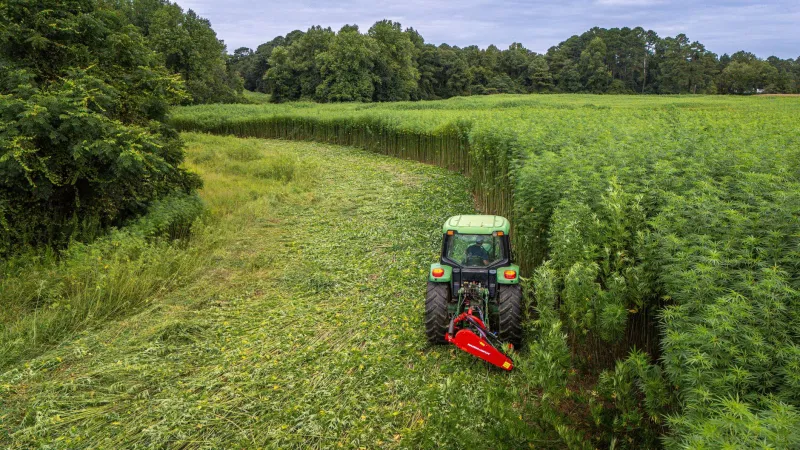
Single-source hemp farming sounds simple enough: your hemp comes from one place, grown under consistent conditions, by people who are accountable for every decision made in that field. But executing it at scale while maintaining product quality? That's a genuinely difficult operational challenge.
It requires owning or maintaining a deeply integrated relationship with specific farmland. It means your growing practices, soil health, water quality, and harvest timing are all variables you control — not variables you're hoping some distant supplier managed correctly. It means when a lab test comes back with a question mark, you can walk back through every step of the process and find your answer.
For Golden Farm, this isn't a marketing talking point — it's the operational backbone of how we make our gummies. Our hemp is cultivated with full visibility into growing conditions, from the nutrients in the soil to the timing of the harvest. That's not a claim we make lightly, because it requires real infrastructure and real commitment to pull off.
The payoff is accountability that runs in both directions. We can answer hard questions about our products because we were present for every chapter of the story.
The Traceability Gap and What It Costs You
When a supplement lacks a traceable supply chain, the risks aren't hypothetical. They show up in real ways:
Potency inconsistency. Hemp grown under different soil conditions, at different altitudes, or harvested at different maturity levels produces cannabinoid profiles that vary significantly. If your CBD gummy is built from blended, multi-source hemp, the milligrams on the label may not reflect what's actually bioavailable in your body — and your experience will be inconsistent from batch to batch.
Contamination risk. Hemp is a bioaccumulator, meaning it readily absorbs whatever is in the soil around it — including heavy metals, pesticides, and industrial runoff. A single-source farm with known soil history is a fundamentally different risk profile than commodity hemp sourced from unknown agricultural land.
No one to call. When something seems off with a supplement from a brand that doesn't control its supply chain, there's genuinely no accountability structure in place. The brand blames the manufacturer. The manufacturer blames the broker. The broker has moved on to the next contract. You're left with a product you can't trust and no clear path to answers.
Single-source farming doesn't just reduce these risks — it creates a structural accountability that mass-market production simply cannot replicate.
What to Actually Look For on a CBD Brand's Website
If you're shopping for CBD gummies and want to separate the accountable brands from the ones coasting on vague language, here are some specific things worth looking for:
- Farm origin information. Does the brand tell you where their hemp is grown? Not just "the USA" — but actual sourcing details that demonstrate they have a direct relationship with their agricultural source.
- Batch-specific testing. Third-party certificates of analysis (COAs) should be linked to specific batches, not just generic product lines. If the COA doesn't have a batch number you can match to your product, it's not doing the job it's supposed to do.
- Vertically integrated claims with substance. Lots of brands say they're "vertically integrated." Ask what that actually means. Does it include farming? Processing? Manufacturing? Or does it just mean they have a warehouse?
- Transparency about what's not in the product. A brand that's genuinely confident in its supply chain will tell you what their testing screens for — pesticides, heavy metals, residual solvents, microbials — not just what it confirms.
At Golden Farm, we welcome these questions. Transparency isn't a PR exercise for us — it's the only way we know how to operate.
Why This Should Matter to Every Wellness Consumer
Here's the thing about the wellness space: it attracts people who are already paying attention to what goes into their bodies. You're reading labels. You're researching ingredients. You're trying to make informed choices in a market that's often designed to obscure rather than illuminate.
That effort deserves to be met with real accountability from the brands you choose. Not just a nice label and a reassuring tagline, but an actual, traceable answer to the question: where did this come from, and how do you know it's what you say it is?
Single-source hemp farming is one of the most concrete ways a CBD brand can demonstrate that it has that answer ready. It's not the easiest path — it's actually significantly harder than the commodity model — but it's the one that holds up when you push on it.
And when it comes to something you're putting in your body every day as part of a wellness routine, "holds up when you push on it" seems like a pretty reasonable standard to set.